


Cleaning Produce Washing Equipment: Root Barrel Washer Checklist
Robert Hadad, Extension Vegetable Specialist
Cornell Vegetable Program
Months of research was conducted on a root barrel washer to determine the best way to clean the equipment given that it was not designed to be easily taken apart and cleaned. Hard-to-reach places were identified through the tracking of vegetable matter and debris dispersed within the barrel washer during use. An acceptable level of cleanliness completed in a reasonable amount of time was identified. The equipment cleanliness was based on visual criteria only; further investigation of the microbial level is still required.
To the best of our efforts, areas of critical cleaning are identified in this checklist as well as all other sections necessary to clean.
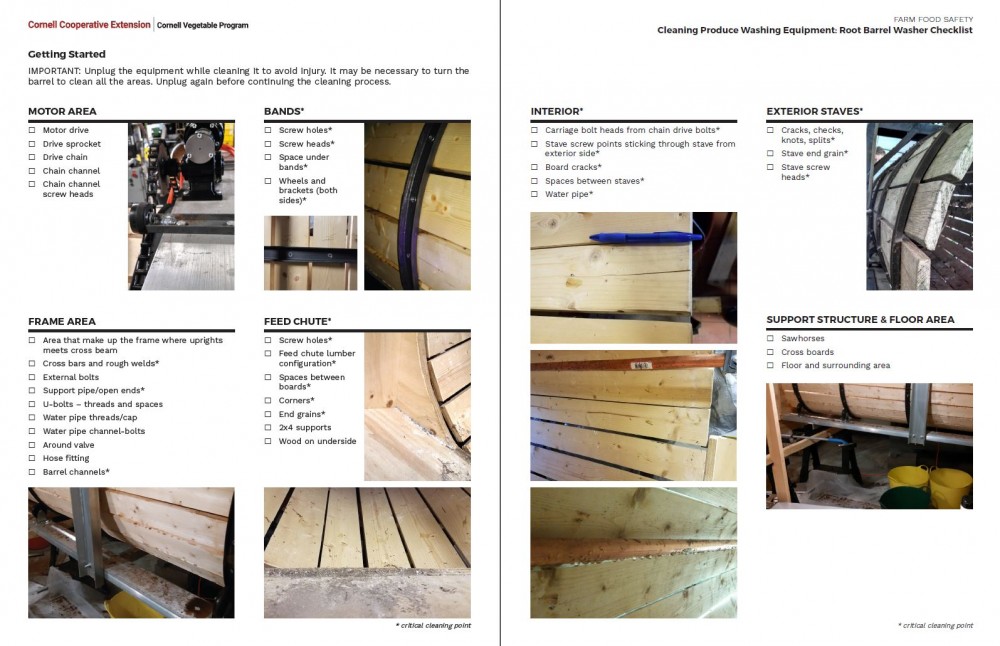
Additional photos and instructions on cleaning a root barrel washer can be found in the presentation below.
Cleaning Produce Washing Equipment: Root Barrel Washer Checklist (pdf; 2389KB)
Presentation: Cleaning a Root Barrel Washer (pdf; 1476KB)


Asparagus

Beets

Broccoli

Brussels Sprouts

Cabbage

Carrots

Cauliflower

Cucumbers

Dry Beans

Eggplant

Ethnic Vegetables

Garlic

Horseradish

Kohlrabi

Leeks

Lettuce / Leafy Greens

Melons

Mushrooms

Onions

Parsnips

Peas

Peppers

Potatoes

Pumpkins / Gourds

Radishes

Rhubarb

Rutabaga

Snap Beans

Squash - Summer

Squash- Winter

Sweet Corn

Sweet Potatoes

Tomatoes

Turnips

Upcoming Events
Chipping Potato and Field Crops Twilight Meeting

August 27, 2026
Dansville, NY
This year, our field meeting is bringing together field crops and chipping potatoes. SWNY Dairy, Livestock, and Field Crops Specialist Katelyn Miller will lead a field crops management discussion. Hear the latest updates in potato disease control and see the Cornell chipping potato variety trial run by Walter De Jong. Dinner follows the educational event.
1.5 DEC credits available in 10, 1a, 21, and 23.
IPM Field Day for Urban Growers
September 10, 2026
Buffalo, NY
Join us for a hands-on field day exploring integrated pest management and season extension tools for urban growing spaces and the opportunity to build community with local growers!
This event will focus on best practices for using row covers and rat mitigation. Check out our CCE demonstration trial using insect exclusion netting to manage swede midge, an invasive fly that causes damage to brassica crops. Explore how to identify rat activity, reduce attractants, and strengthen site management. Hear from local growers on how they manage pests with a focus on organic management and how they extend the season on their farms and gardens.