Best Management Practices in High Tunnel Production: Optimal Tomato Spacing
Judson Reid, Extension Vegetable Specialist
Cornell Vegetable Program
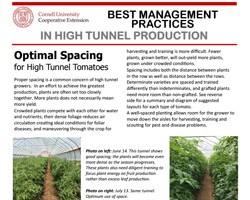
Proper spacing is a common concern of high tunnel growers. More plants does not necessarily mean more yield. Determinate varieties are spaced and trained differently than indeterminates, and grafted plants need more room than non-grafted. A well-spaced planting allows room for the grower to move down the aisles for harvesting, training and scouting for pest and disease problems.
Download the PDF for details on how to optimize your high tunnel tomato spacing.
Best Management Practices in HT Production: Optimal Tomato Spacing, April 2013 (pdf; 550KB)

Upcoming Events
Vegetable Pest and Cultural Management Field Meeting for Auction Growers -- Chautauqua
July 14, 2026
Panama, NY
A field walk will demonstrate pest management in fresh market vegetables in both field and greenhouse (high tunnel) vegetables, primarily for those growing for wholesale auction. CCE Cornell Vegetable Program Specialist Judson Reid will identify weeds, insects and diseases in vegetables and will go over management options such as inter-row cover crops, grafting, and where appropriate, spray options.
DEC recertification credits available: 2.0 in categories 10, 1a, 23 and 24.
Vegetable Pest and Cultural Management Field Meeting for Auction Growers -- Allegany
July 15, 2026
Fillmore, NY
A field walk will demonstrate pest management in fresh market vegetables in both field and greenhouse (high tunnel) vegetables, primarily for those growing for wholesale auction. CCE Cornell Vegetable Program Specialist Judson Reid will identify weeds, insects and diseases in vegetables and will go over management options such as inter-row cover crops, grafting, and where appropriate, spray options.
DEC recertification credits available: 2.0 in categories 10, 1a, 23 and 24.
Pest Management for Small-Scale Growers
July 23, 2026
Rochester, NY
Join us for a hands-on field day exploring integrated pest management tools for small-scale growing spaces and the opportunity to build community with local growers! Learn the best practices for using row covers, biocontrols, trapping, and more.