


Late Blight Sample Collection and Submission to Cornell
Margie Lund, Extension Vegetable Specialist
Cornell Vegetable Program
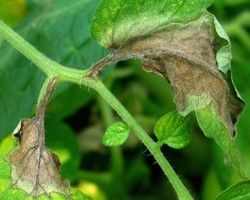
If late blight is detected or suspected on your farm, and you cannot get a sample to a Cornell Vegetable Program staff member in a day or two, you should submit your sample to Chris Smart's lab at Cornell. Following are instructions for reporting, collecting and mailing samples to his lab.
From usablight.org:
Samples must be reported online and a form that is generated from your submission must be included with the sample. You will receive a sample number (which should be written on the sample bag when it is sent to the lab), and this number can be used to track your sample.
Report online and fill out a form. (If you are new to the system you must Register for Sample Submission BEFORE Reporting.)
When sending late blight samples it is better to send leaf tissue rather than fruit or tubers. If you do send fruit or tubers send them in a separate bag or shipment -- so they do not crush the leaf tissue in transit. What to send:
1. A minimum of 5 fresh turgid leaves with actively sporulating lesions. Smaller lesions are best. Collected from several locations when possible.
2. Place the foliage in an air-tight dry plastic (Ziploc) bag with a cushion of air - so the foliage doesn't get crushed. Use a small shipping box rather than an envelope. PLEASE write the sample number on the bag.
3. Send the sample immediately upon collection. If you must "hold" the sample overnight, keep it at 40 - 50 F.
4. Include the completed sample submission form (see instructions for reporting sample online) in the box with the sample.
5. Mail the sample via overnight mail to:
Cornell AgriTech
Attn: Colin Day / Chris Smart
630 West North St, Barton Laboratory
Geneva, NY 14456
E-mail: cds14@cornell.edu
Phone: 315-787-2441


Asparagus

Beets

Broccoli

Brussels Sprouts

Cabbage

Carrots

Cauliflower

Cucumbers

Dry Beans

Eggplant

Ethnic Vegetables

Garlic

Horseradish

Kohlrabi

Leeks

Lettuce / Leafy Greens

Melons

Mushrooms

Onions

Parsnips

Peas

Peppers

Potatoes

Pumpkins / Gourds

Radishes

Rhubarb

Rutabaga

Snap Beans

Squash - Summer

Squash- Winter

Sweet Corn

Sweet Potatoes

Tomatoes

Turnips

Upcoming Events
Vegetable Pest and Cultural Management Field Meeting for Auction Growers -- Ontario

July 28, 2026
Canandaigua, NY
A field walk will demonstrate pest management in fresh market vegetables in both field and greenhouse (high tunnel) vegetables, primarily for those growing for wholesale auction. CCE Cornell Vegetable Program Specialist Judson Reid will identify weeds, insects and diseases in vegetables and will go over management options such as inter-row cover crops, grafting, and where appropriate, spray options.
DEC recertification credits available: 2.0 in categories 10, 1a, 23 and 24.
Vegetable Pest and Cultural Management Field Meeting for Auction Growers -- Seneca
July 29, 2026
Romulus, NY
A field walk will demonstrate pest management in fresh market vegetables in both field and greenhouse (high tunnel) vegetables, primarily for those growing for wholesale auction. CCE Cornell Vegetable Program Specialist Judson Reid will identify weeds, insects and diseases in vegetables and will go over management options such as inter-row cover crops, grafting, and where appropriate, spray options.
DEC recertification credits available: 2.0 in categories 10, 1a, 23 and 24.
Vegetable Pest and Cultural Management Field Meeting for Auction Growers -- Yates
July 31, 2026
Himrod, NY
A field walk will demonstrate pest management in fresh market vegetables in both field and greenhouse (high tunnel) vegetables, primarily for those growing for wholesale auction. CCE Cornell Vegetable Program Specialist Judson Reid will identify weeds, insects and diseases in vegetables and will go over management options such as inter-row cover crops, grafting, and where appropriate, spray options.
DEC recertification credits available: 2.0 in categories 10, 1a, 23 and 24.