Cornell Vegetable Program Enrollment

Program Areas

  • Food Safety
  • Variety Evaluation
  • Market Development
  • Pest Management
  • Cultural Practices

Enrollment Benefits

  • Telephone / Email Consultations
  • VegEdge Newsletter
  • Direct Mailings
  • Educational Meetings & Conferences
  • In-Field Educational Opportunities
  • On-Farm Research Trials

CVP Enrollment Form (PDF; 261KB)

Enrollee Login

Password:

Log In To Access:

  • Issues of VegEdge Newsletters

Not an Enrollee? Enroll Now!

Online Enrollment Form

Early Season Garlic Fertility

Crystal Stewart-Courtens, Extension Vegetable Specialist
Eastern New York Commercial Horticulture

April 26, 2018

The most important time to make nitrogen available to a garlic plant in order to increase yield is shortly after leaf emergence from the ground. Success in providing optimal nitrogen will depend on the nitrogen source you are using and some well-timed assistance from soil biology.

Remember that the nitrogen cycle is driven by biology, and biology is driven by temperature (and soil health!). Organic matter is decomposed partially into ammonium by a suite of microbes before nitrification (see Figure 1 for a handy visual).  As the soil warms, N that is bound in organic matter (slow release N) will be made available, and ammonium nitrogen will turn to nitrate nitrogen (Figure 2), which is easily taken up by plants. 

Bare ground garlic growers can apply their nitrogen in the spring using a variety of sources including very soluble nitrate-nitrogen forms, because the plant will take up the fertilizer readily now. Our latest research is showing that garlic needs no more than 50 lbs/A of N applied in a spring sidedressing.

Nitrogen applied later in the growing cycle of garlic has very little if any effect on the final bulb size. So if you haven't applied your N yet, now is the time! 

Figure 1: Nitrogen cycling, including organic and inorganic forms. 

Figure 2: relationship of nitrification to soil temperature. As temperatures climb, nitrifying bacteria more quickly convert ammonia forms of N to nitrate forms, which are more plant available but also more prone to leaching. 

This article is from the April 26, 2018 edition of ENYCHP Vegetable News.  To read the full newsletter,CLICK HERE.
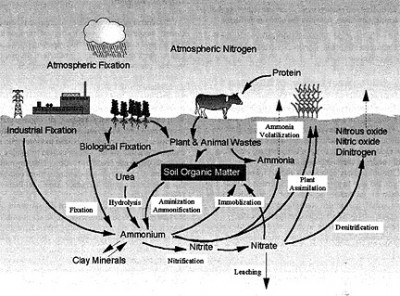
Figure 1
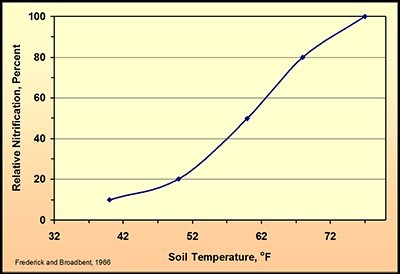
Figure 1


Figure 2


more crops
Asparagus

Asparagus

Beets

Beets

Broccoli

Broccoli

Brussels Sprouts

Brussels Sprouts

Cabbage

Cabbage

Carrots

Carrots

Cauliflower

Cauliflower

Cucumbers

Cucumbers

Dry Beans

Dry Beans

Eggplant

Eggplant

Ethnic Vegetables

Ethnic Vegetables

Garlic

Garlic

Horseradish

Horseradish

Kohlrabi

Kohlrabi

Leeks

Leeks

Lettuce / Leafy Greens

Lettuce / Leafy Greens

Melons

Melons

Mushrooms

Mushrooms

Onions

Onions

Parsnips

Parsnips

Peas

Peas

Peppers

Peppers

Potatoes

Potatoes

Pumpkins / Gourds

Pumpkins / Gourds

Radishes

Radishes

Rhubarb

Rhubarb

Rutabaga

Rutabaga

Snap Beans

Snap Beans

Squash - Summer

Squash - Summer

Squash- Winter

Squash- Winter

Sweet Corn

Sweet Corn

Sweet Potatoes

Sweet Potatoes

Tomatoes

Tomatoes

Turnips

Turnips

more crops

Upcoming Events

IPM Field Day for Urban Growers

September 10, 2026
Buffalo, NY

Join us for a hands-on field day exploring integrated pest management and season extension tools for urban growing spaces and the opportunity to build community with local growers!

This event will focus on best practices for using row covers and rat mitigation. Check out our CCE demonstration trial using insect exclusion netting to manage swede midge, an invasive fly that causes damage to brassica crops. Explore how to identify rat activity, reduce attractants, and strengthen site management. Hear from local growers on how they manage pests with a focus on organic management and how they extend the season on their farms and gardens.

View IPM Field Day for Urban Growers Details

Announcements

Cornell Crop and Pest Management Guidelines Paused

From Cornell IPM:

Highlighting its commitment to quality and long-term sustainability, Cornell Integrated Pest Management's Pesticide Safety Education Program has announced
a pause in production of the 2026 Cornell Crop and Pest Management Guidelines.

Cornell IPM Director Alejandro Calixto said this temporary measure is the result of a comprehensive reimagining process facilitated by Illume Projects of Ithaca, which included end-user interviews, internal surveys and sales data analytics.

"It became clear to us that we cannot continue producing the guidelines and fully restructure them at the same time," Calixto said. "By pausing production, we can dedicate all available resources and time to rebuilding the production process, ensuring that when we re-launch in 2027, the guidelines will reflect a modernized approach built around the grower and other user experience."

A series of annually updated reference manuals produced by Cornell IPM and the College of Agriculture and Life Sciences (CALS), the Cornell Crop and Pest Management Guidelines are widely used by farmers, agronomists, crop consultants and extension educators in New York and throughout the Northeast. They include information about current IPM recommendations, pesticide options, cultural practices, nutrient management, disease, insect and weed identification and resistance-management strategies.

Calixto and Pesticide Safety Education Program Lead Mike Helms will spearhead efforts to restructure the guideline process over the next 12 months, with a goal of launching a more streamlined, user-friendly version in 2027.

Limited copies of the 2025 guidelines remain available for purchase while supplies last through The Cornell Store. The 2026-2027 Greenhouse Guidelines will be available.

For more information contact Helms at mjh14@cornell.edu.


NEWSLETTER  |   CURRENT PROJECTS  |   IMPACT IN NY  |   SPONSORSHIP  |   RESOURCES  |   SITE MAP