Cornell Vegetable Program Enrollment

Program Areas

  • Food Safety
  • Variety Evaluation
  • Market Development
  • Pest Management
  • Cultural Practices

Enrollment Benefits

  • Telephone / Email Consultations
  • VegEdge Newsletter
  • Direct Mailings
  • Educational Meetings & Conferences
  • In-Field Educational Opportunities
  • On-Farm Research Trials

CVP Enrollment Form (PDF; 261KB)

Enrollee Login

Password:

Log In To Access:

  • Issues of VegEdge Newsletters

Not an Enrollee? Enroll Now!

Online Enrollment Form

Common Asparagus Beetle Management During Harvest Season

Ethan Grundberg, Vegetable Specialist
Eastern New York Commercial Horticulture

May 9, 2018

The beginning stages of Common asparagus beetle (Crioceris asparagiI) infestations often go unnoticed. Since the beetles have two to three generations per year (depending upon where you are in our region), the population can build quickly over the course of a couple of years and catch growers off-guard at harvest. 

Overwintered adults emerge from their pupae about the same time that asparagus spears begin to push. They quickly begin to feed on the tender shoots causing a sort of rasping damage that browns quickly in the field or post-harvest. The beetles then mate and deposit their eggs in vertical lines along the spears as shown in the image. After about a week, those eggs hatch into small grubs that continue to feed on spears before pupating in the soil. 

Though the larvae, not adults, are most susceptible to insecticides, growers experiencing significant early damage (the economic threshold is suggested to be when 5%-10% of spears have adults present) may need to use an insecticide to knock down the adults before targeting larvae and later generations on ferns. Given the need to continue harvesting every 1-2 days (a practice that also helps remove eggs from the field to slow the population growth), a short Pre-Harvest Interval (PHI) and Restricted Entry Interval (REI) are key to selecting an appropriate labeled insecticide. 

The standard insecticide options are pyrethroids (IRAC Group 3A), such as Pounce 25 WP and other labeled permethrin formulations (1 day PHI, 12 hour REI) or PyGanic 5.0 (OMRI, 0 day PHI, 12 hour REI). Some neonicitnoids (IRAC Group 4A), such as Assail 70 WP and Anarchy 30 SG (both acetamiprid), are also labeled for asparagus beetle adults and larvae during harvest (1 day PHI, 12 hour REI). Lannate (methomyl, IRAC Group 1A), is also options if you are willing to equip the harvest crew with early entry PPE (1 day PHI, 48 hour REI) to continue removing egg masses on cut spears. An easier option for those looking to use an organophosphate is Sevin XLR Plus (carbaryl, 1 day PHI, 12 hour REI). Note that Lorsban (chlorpyrifos) is sometimes recommended in other states, but IS NOT allowed for use on asparagus in New York. 

For heavily infested fields, continue scouting the asparagus after harvest and target second and/or third generations with any of the options listed above or with IRAC Group 5 spinosyns, such as Radiant or Entrust (OMRI), both of which have a 60 day PHI. Cleaning fields of old stalks after mowing in the fall can also help reduce the overwintering populations.  
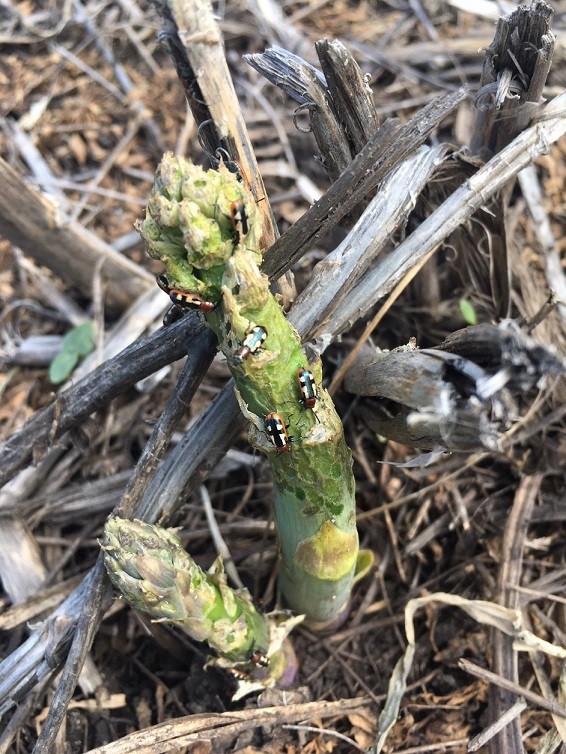
Image 11. Common asparagus beetle adults feeding on an emerging spear
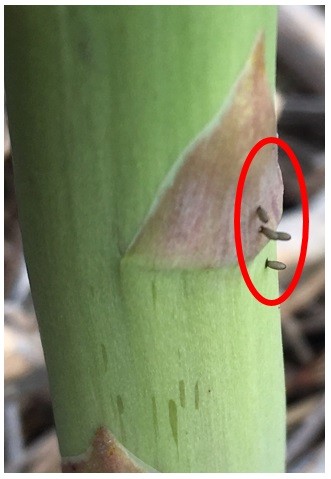
Image 22. Grayish colored asparagus beetle eggs visible in a vertical line on a young spear



more crops
Asparagus

Asparagus

Beets

Beets

Broccoli

Broccoli

Brussels Sprouts

Brussels Sprouts

Cabbage

Cabbage

Carrots

Carrots

Cauliflower

Cauliflower

Cucumbers

Cucumbers

Dry Beans

Dry Beans

Eggplant

Eggplant

Ethnic Vegetables

Ethnic Vegetables

Garlic

Garlic

Horseradish

Horseradish

Kohlrabi

Kohlrabi

Leeks

Leeks

Lettuce / Leafy Greens

Lettuce / Leafy Greens

Melons

Melons

Mushrooms

Mushrooms

Onions

Onions

Parsnips

Parsnips

Peas

Peas

Peppers

Peppers

Potatoes

Potatoes

Pumpkins / Gourds

Pumpkins / Gourds

Radishes

Radishes

Rhubarb

Rhubarb

Rutabaga

Rutabaga

Snap Beans

Snap Beans

Squash - Summer

Squash - Summer

Squash- Winter

Squash- Winter

Sweet Corn

Sweet Corn

Sweet Potatoes

Sweet Potatoes

Tomatoes

Tomatoes

Turnips

Turnips

more crops

Upcoming Events

Vegetable Pest and Cultural Management Field Meeting for Auction Growers -- Yates

Event Offers DEC Credits

July 31, 2026
Himrod, NY

A field walk will demonstrate pest management in fresh market vegetables in both field and greenhouse (high tunnel) vegetables, primarily for those growing for wholesale auction. CCE Cornell Vegetable Program Specialist Judson Reid will identify weeds, insects and diseases in vegetables and will go over management options such as inter-row cover crops, grafting, and where appropriate, spray options. 

DEC recertification credits available: 2.0 in categories 10, 1a, 23 and 24. 

View Vegetable Pest and Cultural Management Field Meeting for Auction Growers -- Yates Details

Small Vegetable Workshop

August 13, 2026
Fulton, NY

Identify vegetables that make sense to grow on small acreage, including under high and low tunnel season extension. Bill Ingersoll, owner of Ingersoll Farms, will provide a short tour and discuss other important factors of running a mixed vegetable farm, including a farm stand and selling at farmers' markets.

View Small Vegetable Workshop Details

Chipping Potato and Field Crops Twilight Meeting

Event Offers DEC Credits

August 27, 2026
Dansville, NY

This year, our field meeting is bringing together field crops and chipping potatoes. SWNY Dairy, Livestock, and Field Crops Specialist Katelyn Miller will lead a field crops management discussion. Hear the latest updates in potato disease control and see the Cornell chipping potato variety trial run by Walter De Jong. Dinner follows the educational event.

1.5 DEC credits available in 10, 1a, 21, and 23.

View Chipping Potato and Field Crops Twilight Meeting Details

Announcements

Cornell Crop and Pest Management Guidelines Paused

From Cornell IPM:

Highlighting its commitment to quality and long-term sustainability, Cornell Integrated Pest Management's Pesticide Safety Education Program has announced
a pause in production of the 2026 Cornell Crop and Pest Management Guidelines.

Cornell IPM Director Alejandro Calixto said this temporary measure is the result of a comprehensive reimagining process facilitated by Illume Projects of Ithaca, which included end-user interviews, internal surveys and sales data analytics.

"It became clear to us that we cannot continue producing the guidelines and fully restructure them at the same time," Calixto said. "By pausing production, we can dedicate all available resources and time to rebuilding the production process, ensuring that when we re-launch in 2027, the guidelines will reflect a modernized approach built around the grower and other user experience."

A series of annually updated reference manuals produced by Cornell IPM and the College of Agriculture and Life Sciences (CALS), the Cornell Crop and Pest Management Guidelines are widely used by farmers, agronomists, crop consultants and extension educators in New York and throughout the Northeast. They include information about current IPM recommendations, pesticide options, cultural practices, nutrient management, disease, insect and weed identification and resistance-management strategies.

Calixto and Pesticide Safety Education Program Lead Mike Helms will spearhead efforts to restructure the guideline process over the next 12 months, with a goal of launching a more streamlined, user-friendly version in 2027.

Limited copies of the 2025 guidelines remain available for purchase while supplies last through The Cornell Store. The 2026-2027 Greenhouse Guidelines will be available.

For more information contact Helms at mjh14@cornell.edu.


NEWSLETTER  |   CURRENT PROJECTS  |   IMPACT IN NY  |   SPONSORSHIP  |   RESOURCES  |   SITE MAP