Cornell Vegetable Program Enrollment

Program Areas

  • Food Safety
  • Variety Evaluation
  • Market Development
  • Pest Management
  • Cultural Practices

Enrollment Benefits

  • Telephone / Email Consultations
  • VegEdge Newsletter
  • Direct Mailings
  • Educational Meetings & Conferences
  • In-Field Educational Opportunities
  • On-Farm Research Trials

CVP Enrollment Form (PDF; 261KB)

Enrollee Login

Password:

Log In To Access:

  • Issues of VegEdge Newsletters

Not an Enrollee? Enroll Now!

Online Enrollment Form

A Spring Tale of Springtails

Teresa Rusinek, Vegetable Specialist
Eastern New York Commercial Horticulture

May 17, 2018

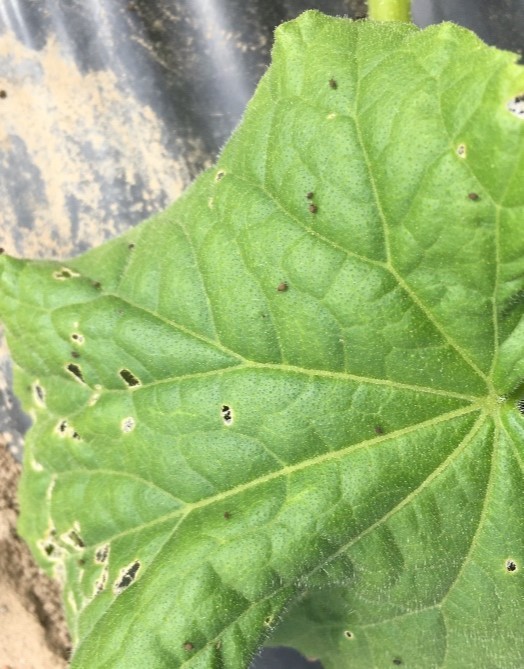
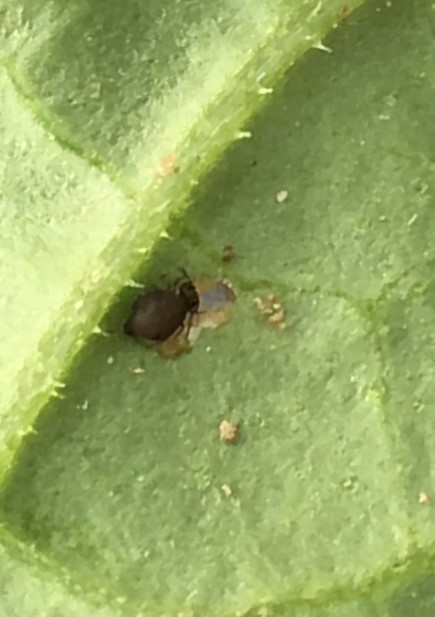
Last week, I went to check on a problem a grower was having in his high tunnel cucumber crop.  Carefully inspecting the leaves, I found many tiny, 1/16th of inch-long insects all over the cucumber plants. They jumped about from one cucumber plant to the next, munching away at tender foliage that was beginning to look like Swiss cheese! 

The minuscule insects turned out to be springtails. In my 20+ years diagnosing vegetable pest problems, I've never come across these as a crop pest.  For the most part springtails, also known as Collembola, feed on decaying plant material and are considered beneficial. But, under dry soil conditions, springtails seeking moisture may feed on and cause significant injury to young plants. The damage and appearance of springtails can look very much like flea beetles, but we don't typically see flea beetles attacking cucumber and the springtails are about half the size of a flea beetle. Similar to a flea beetle, they will spring away when disturbed using a structure under their abdomen called a furcular.

Springtails have been reported feeding on many veg crops including beans, beets broccoli potato radish, and even garlic. According to Cornell pest management guidelines, "These insects are generally susceptible to insecticides and are likely to be controlled when an application is made to control another seedling pest."

 Springtails lay eggs in moist soil with high organic matter. The eggs hatch out into juveniles in about 10 days and then molt multiple times throughout the season. Adults may live through the year but only seem to be a problem to crops in May or June when plants are small and tender. 

  This article is from the May 17 2018 edition of the ENYCHP Vegetable News.  Click Here to view the full newsletter.


more crops
Asparagus

Asparagus

Beets

Beets

Broccoli

Broccoli

Brussels Sprouts

Brussels Sprouts

Cabbage

Cabbage

Carrots

Carrots

Cauliflower

Cauliflower

Cucumbers

Cucumbers

Dry Beans

Dry Beans

Eggplant

Eggplant

Ethnic Vegetables

Ethnic Vegetables

Garlic

Garlic

Horseradish

Horseradish

Kohlrabi

Kohlrabi

Leeks

Leeks

Lettuce / Leafy Greens

Lettuce / Leafy Greens

Melons

Melons

Mushrooms

Mushrooms

Onions

Onions

Parsnips

Parsnips

Peas

Peas

Peppers

Peppers

Potatoes

Potatoes

Pumpkins / Gourds

Pumpkins / Gourds

Radishes

Radishes

Rhubarb

Rhubarb

Rutabaga

Rutabaga

Snap Beans

Snap Beans

Squash - Summer

Squash - Summer

Squash- Winter

Squash- Winter

Sweet Corn

Sweet Corn

Sweet Potatoes

Sweet Potatoes

Tomatoes

Tomatoes

Turnips

Turnips

more crops

Upcoming Events

Fungi, Forage & Forest

June 12, 2026 : Friday Evening

Buckets, Beds & Totems
Explore mushroom cultivation techniques featuring oyster mushrooms, wine caps, and lion's mane mushrooms.


June 13, 2026 : Saturday Full-Day

Wild Edibles
Learn about edible plants and responsible foraging practices focused on plants only (no wild mushroom foraging).

Agroforestry Talk
Discover how agroforestry systems can support farm diversification and sustainable land management.

Shiitake Inoculation (hands-on workshop at Heartland Organics)
Participate in a hands-on shiitake inoculation workshop and learn the basics of log-grown mushroom production.

View Fungi, Forage & Forest Details

2026 Muck Onion Growers Twilight Meeting in Oswego

Event Offers DEC Credits

June 18, 2026
Oswego, NY

Open to all Onion Enthusiasts, the Muck Onion Growers Twilight Meeting will include an onion disease research update from 2025, new fungicide recommendations for 2026, an onion maggot seed treatment update, herbicide demonstration tour, and more. This educational event is immediately followed by a catered dinner; both are FREE thanks to generous sponsors!

2.25 DEC recertification credits available in categories 1a, 10 and 23. CCA credits will be offered too.

View 2026 Muck Onion Growers Twilight Meeting in Oswego Details

Announcements

Cornell Crop and Pest Management Guidelines Paused

From Cornell IPM:

Highlighting its commitment to quality and long-term sustainability, Cornell Integrated Pest Management's Pesticide Safety Education Program has announced
a pause in production of the 2026 Cornell Crop and Pest Management Guidelines.

Cornell IPM Director Alejandro Calixto said this temporary measure is the result of a comprehensive reimagining process facilitated by Illume Projects of Ithaca, which included end-user interviews, internal surveys and sales data analytics.

"It became clear to us that we cannot continue producing the guidelines and fully restructure them at the same time," Calixto said. "By pausing production, we can dedicate all available resources and time to rebuilding the production process, ensuring that when we re-launch in 2027, the guidelines will reflect a modernized approach built around the grower and other user experience."

A series of annually updated reference manuals produced by Cornell IPM and the College of Agriculture and Life Sciences (CALS), the Cornell Crop and Pest Management Guidelines are widely used by farmers, agronomists, crop consultants and extension educators in New York and throughout the Northeast. They include information about current IPM recommendations, pesticide options, cultural practices, nutrient management, disease, insect and weed identification and resistance-management strategies.

Calixto and Pesticide Safety Education Program Lead Mike Helms will spearhead efforts to restructure the guideline process over the next 12 months, with a goal of launching a more streamlined, user-friendly version in 2027.

Limited copies of the 2025 guidelines remain available for purchase while supplies last through The Cornell Store. The 2026-2027 Greenhouse Guidelines will be available.

For more information contact Helms at mjh14@cornell.edu.


NEWSLETTER  |   CURRENT PROJECTS  |   IMPACT IN NY  |   SPONSORSHIP  |   RESOURCES  |   SITE MAP