Cornell Vegetable Program Enrollment

Program Areas

  • Food Safety
  • Variety Evaluation
  • Market Development
  • Pest Management
  • Cultural Practices

Enrollment Benefits

  • Telephone / Email Consultations
  • VegEdge Newsletter
  • Direct Mailings
  • Educational Meetings & Conferences
  • In-Field Educational Opportunities
  • On-Farm Research Trials

CVP Enrollment Form (PDF; 261KB)

Enrollee Login

Enter Password:

Log In To Access:

  • Issues of VegEdge Newsletters

Not an Enrollee? Enroll Now!

Online Enrollment Form

Not an Enrollee? Enroll Now!

Online Enrollment Form

Event Offers DEC Credits

Event Details

Date

December 5, 2019

Time

10:15am-1:00pm

Location

Pine Island Fire Department
684 County Rd 1
Pine Island, NY 10969

Cost

This event is free.

Host

Cornell Vegetable Program


Reduced Tillage on Muck Soils: Results from Two Years of Squash Trials

December 5, 2019
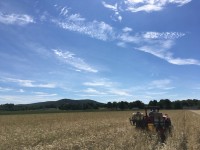
Reduced Tillage on Muck Soils: Results from Two Years of Squash Trials

10:15 AM-10:30- Welcome and Introductions, Ethan Grundberg, CCE ENYCHP 

10:30-11:15- Weed Management in Heavy Residue Reduced Tillage Systems, Chuck Bornt, CCE ENYCHP

Bornt will present data from two years of trialing different cover crop mixtures and planting densities to create residue for reduced tillage squash production systems on muck soils. Emphasis will be placed on combining cultural tactics, such as avoidance of moldboard plowing pre-cover crop establishment, and chemical tactics for reducing weed pressure. Specific results on the variable performance of burndown herbicides, particularly glyphosate and paraquat, for cover crop management in combination with pre-emergent herbicides, particularly Sandea and Command, will be presented. 

11:15-11:50- Managing Primary Cucurbit Pests and Diseases in Reduced Tillage Systems
, Ethan Grundberg, CCE ENYCHP

Grundberg will discuss the measured impacts of adopting reduced tillage systems on several of the primary pests and diseases of cucurbit crops in the region. Specifically, Grundberg will present data on the incidence of Phytopthora capsici, the percent of crop damaged by rodents, and the fungicide programs used to manage powdery mildew and downy mildew in trial plots in 2018 and 2019. Data on soil temperature and moisture across different cover crop treatments and their interaction with soilborne pathogens like Pythium spp will also be presented.

11:50-12:00- Reduced Tillage Trials in 2020, Chuck Bornt and Ethan Grundberg, CCE ENYCHP

Grundberg and Bornt will discuss the future direction of reduced tillage trials in Orange County, specifically addressing the need for trialing in transplanted crops and possible impacts of reduced tillage systems on greenhouse gas flux.

12:00-1:00 PM- Catered lunch


*Drive around the rear of the building to the large parking lot.  The entrance to the social room is through the set of double doors to the left of the main doors under the awning. 



more crops
Asparagus

Asparagus

Beets

Beets

Broccoli

Broccoli

Brussels Sprouts

Brussels Sprouts

Cabbage

Cabbage

Carrots

Carrots

Cauliflower

Cauliflower

Cucumbers

Cucumbers

Dry Beans

Dry Beans

Eggplant

Eggplant

Ethnic Vegetables

Ethnic Vegetables

Garlic

Garlic

Horseradish

Horseradish

Kohlrabi

Kohlrabi

Leeks

Leeks

Lettuce / Leafy Greens

Lettuce / Leafy Greens

Melons

Melons

Mushrooms

Mushrooms

Onions

Onions

Parsnips

Parsnips

Peas

Peas

Peppers

Peppers

Potatoes

Potatoes

Pumpkins / Gourds

Pumpkins / Gourds

Radishes

Radishes

Rhubarb

Rhubarb

Rutabaga

Rutabaga

Snap Beans

Snap Beans

Squash - Summer

Squash - Summer

Squash- Winter

Squash- Winter

Sweet Corn

Sweet Corn

Sweet Potatoes

Sweet Potatoes

Tomatoes

Tomatoes

Turnips

Turnips

more crops

Upcoming Events

No upcoming events at this time.

Announcements

Cornell Crop and Pest Management Guidelines Paused

From Cornell IPM:

Highlighting its commitment to quality and long-term sustainability, Cornell Integrated Pest Management's Pesticide Safety Education Program has announced
a pause in production of the 2026 Cornell Crop and Pest Management Guidelines.

Cornell IPM Director Alejandro Calixto said this temporary measure is the result of a comprehensive reimagining process facilitated by Illume Projects of Ithaca, which included end-user interviews, internal surveys and sales data analytics.

"It became clear to us that we cannot continue producing the guidelines and fully restructure them at the same time," Calixto said. "By pausing production, we can dedicate all available resources and time to rebuilding the production process, ensuring that when we re-launch in 2027, the guidelines will reflect a modernized approach built around the grower and other user experience."

A series of annually updated reference manuals produced by Cornell IPM and the College of Agriculture and Life Sciences (CALS), the Cornell Crop and Pest Management Guidelines are widely used by farmers, agronomists, crop consultants and extension educators in New York and throughout the Northeast. They include information about current IPM recommendations, pesticide options, cultural practices, nutrient management, disease, insect and weed identification and resistance-management strategies.

Calixto and Pesticide Safety Education Program Lead Mike Helms will spearhead efforts to restructure the guideline process over the next 12 months, with a goal of launching a more streamlined, user-friendly version in 2027.

Limited copies of the 2025 guidelines remain available for purchase while supplies last through The Cornell Store. The 2026-2027 Greenhouse Guidelines will be available.

For more information contact Helms at mjh14@cornell.edu.