Copper Fungicides for Organic Disease Management in Vegetables
September 16, 2013
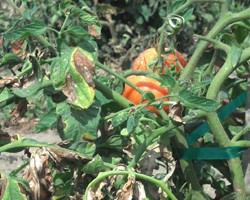
There are several different copper fungicides approved for use in organically-produced crops. Copper fungicides are important tools for managing diseases that cannot be effectively managed with cultural practices alone. They have broad-spectrum activity, acting on bacteria as well as fungi. Following many years of use, there is a lot more information on efficacy of copper fungicides than the newer biological products. Manufacturers of some biologicals recommend that they be used in a management program with copper fungicides (often in alternation or at low label rate). Thus it appears copper fungicides will continue to be important for managing diseases. Copper fungicides differ in their active ingredient, use rate, re-entry interval, and the amount of copper. Copper is an inorganic compound thus it does not breakdown like organic compounds and consequently copper can accumulate in soil when used intensively. Plants take up some copper from soil because it is a micronutrient. Similarly, humans need a small amount of copper in their diets. Metallic copper equivalent (MCE) is a commonly used measure of the quantity of copper in fungicides.
Click here for a chart on the Highest Label Rate of Organic Copper Fungicides for Some Vegetable Crops.
The specific directions on fungicide labels must be adhered to. They supersede these recommendations (above), if there is a conflict. Check state registration and organic approval before using a product. Any reference to commercial products, trade or brand names is for information only; no endorsement is intended.
Highest Label Rate of Organic Copper Fungicides for Some Vegetable Crops (pdf; 198KB)


Asparagus

Beets

Broccoli

Brussels Sprouts

Cabbage

Carrots

Cauliflower

Cucumbers

Dry Beans

Eggplant

Ethnic Vegetables

Garlic

Horseradish

Kohlrabi

Leeks

Lettuce / Leafy Greens

Melons

Mushrooms

Onions

Parsnips

Peas

Peppers

Potatoes

Pumpkins / Gourds

Radishes

Rhubarb

Rutabaga

Snap Beans

Squash - Summer

Squash- Winter

Sweet Corn

Sweet Potatoes

Tomatoes

Turnips