Set Up an Efficient Wash/Pack Facility
Robert Hadad, Extension Vegetable Specialist
Cornell Vegetable Program
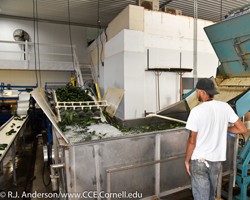
The goal of this document is to provide more detail on setting up an efficient wash/pack facility with a focus on farm food safety and maintaining post-harvest quality. Of course, each farm will have unique circumstances and need different pieces of equipment. The idea here is think about the way to use a space to your best advantage. A facility should be set up to wash and move produce efficiently while getting the job done effectively. Whether you are adapting a currently existing space or starting from scratch, you can use this document to plan as close to the ideal situation as possible. You can customize to your specific situation, budget and needs.
The "Ideal" Wash and Pack Facility Layout (pdf; 485KB)

Upcoming Events
Orleans Regional Winter Vegetable Meeting
February 9, 2026
Albion, NY
Topics include: Breeding and evaluating tomatoes to control disease and improve yield, jar testing and ensuring spray water quality, breaking down organic matter, FSMA updates and Q&A with Ag & Markets, and industry updates. Includes hands-on learning, coffee break, and sponsor booths.
DEC credits available: 1.0 in CORE plus 0.5 in 1a, 10 or 23
African Eggplant Participatory Breeding Kick-Off
March 5, 2026
Join us to learn about the Cornell African Eggplant Research Project and learn how you can participate! African eggplant, also known as Bitterball, Garden Egg, Kittley and other names, is an important crop for many members of our community with heritage from regions such as sub-Saharan Africa, Southeast Asia, and Brazil. Since 2024, the Cornell African Eggplant Research Project has been collaborating with growers and community partners across New York to develop high-quality varieties adapted to the Northeast U.S. In this meeting, we will share information about growing and preparing African eggplant, highlight our research to date, and invite partners to collaborate with us in our 2026 participatory breeding and variety selection efforts.
COST: FREE! You must pre-register to receive the Zoom link.
Managing the Invasive Swede Midge Webinar
March 6, 2026
Swede midge is an invasive fly that causes serious economic losses to brassica crops. Due to its small size and hidden feeding habits, swede midge is often called an "invisible pest" and damage may be misdiagnosed. In this webinar, we will review the swede midge life cycle and crop damage symptoms, current management recommendations, new research findings, and highlights from on-farm case studies with a focus on organic management.
1.75 DEC pesticide recertification credits in categories 1a, 10, and 23.