


Stop the Rot! - Using Cultural Practices to Manage Bacterial Diseases of Onion
Christy Hoepting, Extension Vegetable Specialist
Cornell Vegetable Program
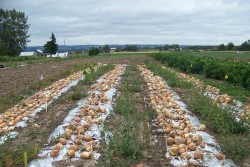
Do you know how easy this is? A simple modification to adjust your planting configuration is all it would take to drastically reduce losses from bacterial bulb decay. Our studies showed that when plant spacing was reduced from 6 or 8 inches to 4 inches with 3 or 4 rows per 3-foot plastic mulch bed (row spacing: 4 rows = 6 inch; 3 rows = 8 inch), this provided 53 to 64% control of bacterial bulb decay at harvest (Table 1). Marketable yield also increased by 1.4 to 2.4 times, representing an increased net economic return of $43 to $258 per 100 feet of bed, due to increased weight of marketable jumbo-sized bulbs (Table 1). We learned that wide plant spacing produces big bushy plants with more leaves, thicker necks, delayed maturity and bigger bulbs. Unfortunately, it was these bigger bulbs that rotted! By narrowing plant spacing, we got fewer colossal-sized bulbs, which we more than made up for by having significantly more healthy jumbo-sized bulbs to market (Table 1).
Alternatives to black plastic reduced bacterial bulb decay by 59 to 75%
This is also a very simple and easy modification for small-scale growers producing onions on plastic mulch to make to their cultural practices that could go a very long way towards reducing bacterial bulb decay. Our studies showed that reflective silver mulch, biodegradable black plastic and bare ground had significantly 1.8 to 2.8 times higher marketable yield than black plastic (Table 2). Reflective silver and biodegradable black plastics had significantly 3.7 and 3.6 times, respectively, higher jumbo weight than black plastic, which resulted in an increased net return of $96 to $215 per 100 feet of bed compared to black plastic (Table 2). All of the alternatives to black plastic had significantly lower soil temperatures compared to the black plastic; we suspect that the higher temperatures of the black plastic are more favorable for development of bacterial diseases.
Stop the Rot article (pdf; 1356KB)


Asparagus

Beets

Broccoli

Brussels Sprouts

Cabbage

Carrots

Cauliflower

Cucumbers

Dry Beans

Eggplant

Ethnic Vegetables

Garlic

Horseradish

Kohlrabi

Leeks

Lettuce / Leafy Greens

Melons

Mushrooms

Onions

Parsnips

Peas

Peppers

Potatoes

Pumpkins / Gourds

Radishes

Rhubarb

Rutabaga

Snap Beans

Squash - Summer

Squash- Winter

Sweet Corn

Sweet Potatoes

Tomatoes

Turnips

Upcoming Events
IPM Field Day for Urban Growers
September 10, 2026
Buffalo, NY
Join us for a hands-on field day exploring integrated pest management and season extension tools for urban growing spaces and the opportunity to build community with local growers!
This event will focus on best practices for using row covers and rat mitigation. Check out our CCE demonstration trial using insect exclusion netting to manage swede midge, an invasive fly that causes damage to brassica crops. Explore how to identify rat activity, reduce attractants, and strengthen site management. Hear from local growers on how they manage pests with a focus on organic management and how they extend the season on their farms and gardens.