Know the Difference: Botrytis Leaf Blight Halo Lesions vs BLB Necrotic Spots
Christy Hoepting, Extension Vegetable Specialist
Cornell Vegetable Program
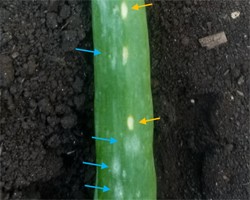
Through recent on-farm fungicide trials, we've determined that not all Botrytis leaf blight (BLB) lesions are controlled equally. There are two kinds of BLB lesions: BLB halo lesions and BLB necrotic spots and your best fungicide options for control of Botrytis leaf blight depends on what kind of spot you got! See Know the Difference: Botrytis Leaf Blight Halo Lesions vs BLB Necrotic Spots for photos.
BLB Halo LesionsWhen BLB first occurs in June and early July, the lesions appear as a tiny yellow necrotic spot surrounded by a silvery halo. It is also common for the necrotic spot to be absent leaving just a silvery spot (Fig. 1). When BLB halo lesions get old, the center becomes sunken and often splits; it is still yellowish in color and remnants of the silvery halo can usually still be seen (Fig. 2).
See Scouting Onions for Botrytis Leaf Blight Halo Lesions for more more information and photos.
During the second half of July, BLB lesions often do not have the silvery halo. Instead, they are yellow spots, sometimes yellowish-white spots as they get bigger, with a round defined border, that are pin-prick to 1 mm or slightly larger in size (= BLB necrotic spots) (Fig. 1 and Fig. 3). By August, BLB necrotic spots are often dominant, while BLB halo lesions decline, especially in Elba muck. BLB halo lesions tend to linger for the duration of the season in Wayne and Oswego muck-onion growing regions, although both do occur.
BLB necrotic spots are not to be confused with old BLB halo lesions where the initial necrotic spot becomes sunken and often split (Fig. 2). BLB necrotic spots could also be confused with contact herbicide injury.
Know the Difference: Botrytis Leaf Blight Halo Lesions vs BLB Necrotic Spots (pdf; 264KB)


Asparagus

Beets

Broccoli

Brussels Sprouts

Cabbage

Carrots

Cauliflower

Cucumbers

Dry Beans

Eggplant

Ethnic Vegetables

Garlic

Horseradish

Kohlrabi

Leeks

Lettuce / Leafy Greens

Melons

Mushrooms

Onions

Parsnips

Peas

Peppers

Potatoes

Pumpkins / Gourds

Radishes

Rhubarb

Rutabaga

Snap Beans

Squash - Summer

Squash- Winter

Sweet Corn

Sweet Potatoes

Tomatoes

Turnips