


Spray Guidelines to Manage Fungicide Resistance
Laura McDermott, Team Leader, Small Fruit and Vegetable Specialist
Eastern New York Commercial Horticulture
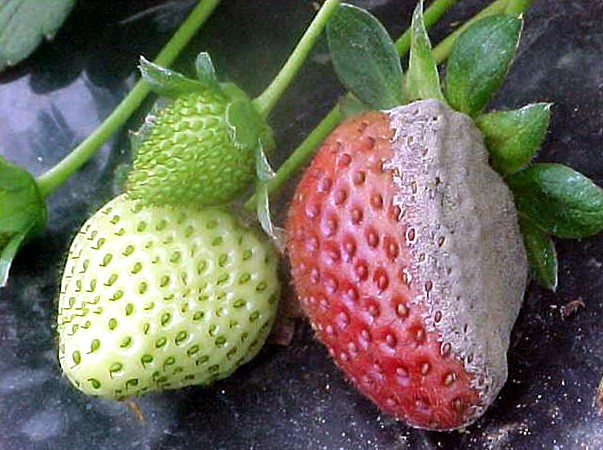 Botrytis cinerea, the causal agent of gray mold on strawberry, on infected fruit.
Note dusty covering of gray spores on infected fruit. Courtesy of APS image database: IW000098
Written by Dr. Cassandra Swett
Here's a strawberry spray guide that manages fungicide resistance, when your main objective is gray mold (Botrytis) protection:
Pre-bloom (crown rot protection)
Spray: Every 7-10 days
Rotating: Captan 50 WG or 80 WDG (group M)
With: Rovral 50 WG (Group 2) --this compound can only be applied once, and only pre-bloom
Early Bloom (10%) to fruit set
Spray: Every 7-10 days
Rotating: Elevate 50 WDG (group 17), CaptEvate (group M + 17), Switch 62.5 WG (group 9 + 12), Fontelis* (group 7), Scala (group 12) and Pristine WG (group 7 + 11)
With: Captan or Thiram Granuflo+ (both group M)
An example: Captan+Fontelis*, then Switch, then Captan, then Pristine, then Thiram+, then Elevate, then Captan
After fruit set:
Spray: Every 7-10 days
Rotating: Captan and Thiram+ (both group M)
With: CaptEvate (group M + 17), Elevate (group 17), or Fontelis* (group 7) -each applied only once during this interval.
Rates
For every compound, there is a range in the rate you can apply. For fungicides at risk of resistance (Switch, Pristine, Rovral, Scala), the lower rate is always recommended. For fungicides that are not at a high chance of resistance (Elevate, Fontelis*, Captan, Thiram+), the amount you apply should be adjusted, in part, based on how high disease pressure is. If it rained at least once since your last spray, and temperatures are between 65 and 75⁰ F, you will want to use the higher concentration. If, in contrast, it's been cooler than 65, warmer than 75 and / or dry, use the lower rate.
Timing
The same goes for how often you spray. We get a lot of rain this time of year, and every time it rains the fungus has a chance to infect plants. So long as it's raining about every week, plan to spray every 7-10 days.
Tips
- Control is improved when you rotate between Fontelis* and Switch and when you tank mix Fontelis with Captan.
- One of the compounds in Pristine is the same FRAC group as Fontelis*, so don't use these sequentially.
- Switch and Pristine are both highly effective, but are at high risk of resistance if they are used too often. Because of this, it is recommended that they are only used ONCE each year.
What about non-synthetic chemicals?
There is some interest in using non-synthetic chemicals for fruit rot control, as a rotation with synthetic chemicals, especially in post bloom control, and for organic management. One such compound is Regalia, a plant extract labeled for use on gray mold and anthracnose fruit rot in strawberry. Trials are lacking for strawberries, but in grape Regalia can be as effective as Pristine against Colletotrichum, and is moderately effective against Botrytis. In trials in California, disease control with Regalia is best when rotated with conventional compounds. We will be doing work on strawberry starting this year to evaluate Regalia and other bio-pesticides / biologicals, so we should have more information on this in future years.
*Fontelis is not labelled in NYS.
+Thiram Granuflo is labelled but is NOT listed in the 2015 Cornell Pest Management Guidelines for Berry Crops.
Source: Penn State Extension, Small Fruit Blog http://extension.psu.edu/plant....
This article is from the April 11, 2018 CCE ENYCHP Berry News, Click Here for the FULL NEWSLETTER


Asparagus

Beets

Broccoli

Brussels Sprouts

Cabbage

Carrots

Cauliflower

Cucumbers

Dry Beans

Eggplant

Ethnic Vegetables

Garlic

Horseradish

Kohlrabi

Leeks

Lettuce / Leafy Greens

Melons

Mushrooms

Onions

Parsnips

Peas

Peppers

Potatoes

Pumpkins / Gourds

Radishes

Rhubarb

Rutabaga

Snap Beans

Squash - Summer

Squash- Winter

Sweet Corn

Sweet Potatoes

Tomatoes

Turnips

Upcoming Events
Chipping Potato and Field Crops Twilight Meeting

August 27, 2026
Dansville, NY
This year, our field meeting is bringing together field crops and chipping potatoes. SWNY Dairy, Livestock, and Field Crops Specialist Katelyn Miller will lead a field crops management discussion. Hear the latest updates in potato disease control and see the Cornell chipping potato variety trial run by Walter De Jong. Dinner follows the educational event.
1.5 DEC credits available in 10, 1a, 21, and 23.
IPM Field Day for Urban Growers
September 10, 2026
Buffalo, NY
Join us for a hands-on field day exploring integrated pest management and season extension tools for urban growing spaces and the opportunity to build community with local growers!
This event will focus on best practices for using row covers and rat mitigation. Check out our CCE demonstration trial using insect exclusion netting to manage swede midge, an invasive fly that causes damage to brassica crops. Explore how to identify rat activity, reduce attractants, and strengthen site management. Hear from local growers on how they manage pests with a focus on organic management and how they extend the season on their farms and gardens.